
Riding Away Where the Buffalo Roam
“Discovering unexpected landscapes and rare wildlife in Grasslands National Park”
By Jamie Ross
“Who said Saskatchewan was flat?” I whisper to my horse Gus as he gamely hauls my butt up another steep incline. The question was meant to be rhetorical, but with a sharp expulsion of air, from both ends of his body, the horse gives me his answer.

My palomino and I pick our way through silver sagebrush, prairie grass, prickly pear cactus, primrose and cottonwood, down through wet coulees and up the side of sandy ravines, trotting upwards until we reach a viewpoint over a valley carved out by ancient glaciers. Far from being flat, here an undulating landscape of hoodoos, dry cliffs and rocky buttes spreads out to the horizon. This breathtaking view of the badlands in the Valley of 1,000 Devils is stunning, and very unique. Erosion by glacial meltwater formed many of the park's characteristic features. This is the East Block of Grasslands National Park in southern Saskatchewan, a remote and beautiful gem.

Established in 1981, Grasslands National Park is one of Canada's newest parks, protecting one of the largest remnants of undisturbed dry mixed-grass prairie grasslands. Four and a half hours south west of Regina and a stone’s throw from Montana, the park not only protects some beautifully unique flora, it’s also home to countless species of rare birds (including sage-grouse, burrowing owls and ferruginous hawks), as well as wild bison, prairie rattlesnakes, pronghorn antelope, short-horned lizards, black-footed ferrets, prairie dogs, bears, coyotes, Swift fox, elk and badger. The unique landscape and harsh, semi-arid climate provide niches for several specially-adapted plants and animals.
Grassland National Park is made up of two distinct and separate blocks. The East Block of the park, where I have done my day’s riding, is more of a wilderness area. While working the International Boundary Survey in 1874, Sir George Mercer Dawson discovered western Canada's first dinosaur remains here, evidence of the Tyrannosaurus, Triceratops and other dinosaurs that once roamed these lands.
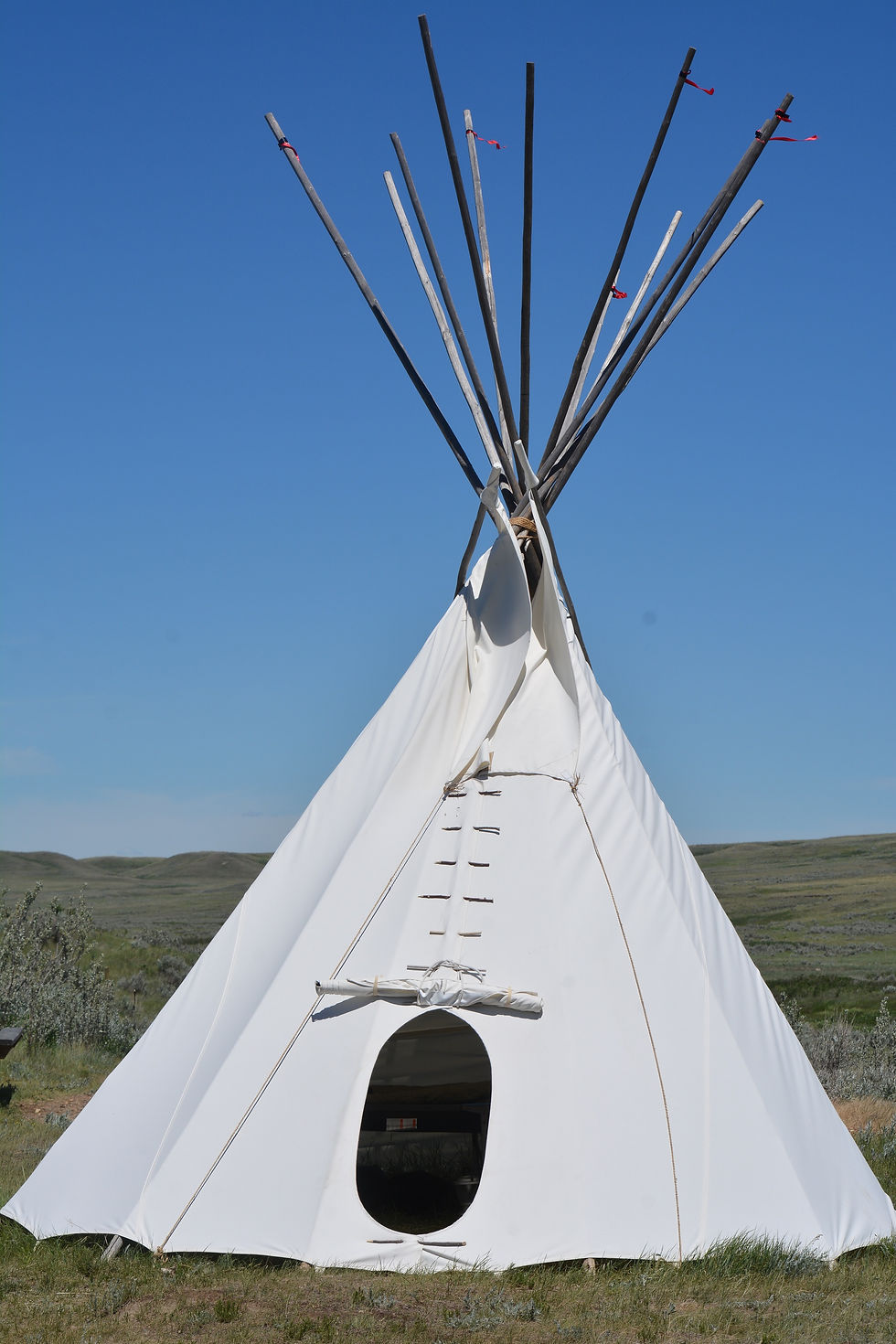
Later in 1877, Sitting Bull took refuge in the area after the defeat of General Custer at the Battle of Little Bighorn. Teepee rings and stone tools of the First Nations people have been found throughout these ancient hills. I feel a little like Sitting Bull, after a day in the saddle I settle into my overnight teepee accommodations at the Rock Creek Campground.
Outside of my traditional accommodation is one of the starriest night skies I have experienced. In Grasslands Park, it's not just the land that's protected, but also the sky. The park is so far from cities and towns and other sources of light that in 2009 the Royal Astronomical Society of Canada declared the park a Dark Sky Preserve. The Dark Sky Preserve is not only good for attracting star-gazers and astronomers, it’s also beneficial for the habitat of nocturnal species, such as the black footed ferret, which was recently re-introduced into the area.
In the early morning I awake to an enchanting prairie soundscape; I am serenaded by birdsong, crickets, chirping prairie dogs and the distant call of a lone coyote, as well as the constant sound of wind gently moving the prairie grass. Park interpreter Brenda Peterson serves up a cowboy breakfast at the McGowan Visitor Centre. Brenda comes from a local ranching family who sold and traded land that is now part of the park. The former teacher and school principal explains that her family was at first against the park, thinking that long-time homesteaders would be forced off their ranches; but no land was appropriated by Parks Canada, and the park is still growing as area ranchers reach retirement and sell their property to the preserve. Brenda is now an enthusiastic steward of the land and park, and a wonderful source of knowledge.

Grassland’s West Block is one hour south of Swift Current, with the main visitor reception centre located in the town of Val Marie. I set up for the night in one of Parks Canada’s unique and comfortable oTENTiks, and then, as the sun drops lower in a pink sky, I head up above the Frenchman Valley to the plateau in search of evening wildlife. I come across two large bison grazing lazily on the wide plain, so close that I can hear them pawing the dusty ground and tearing at the tender grass. These are truly majestic creatures and I find it hard to imagine when millions of bison roamed freely over these same plains. Here in Grasslands, 71 bison were re-introduced back to the park in 2005 after being gone for 120 years. Now there are over 300 bison and 40 calves.
While I am watching the bison, I can’t help but get the sense that I am in turn being kept under surveillance by some strange and curious creatures. The park and surrounding area house the country's only colonies of barking black-tailed prairie dogs. Their burrows spread out like craters on the moon. They pop up and down in their holes, chirping shrilly in alarm.

To fully experience the subtle beauty of the park you have to get out for a ride or a hike to explore. The most accessible front-country hiking is found in the west block of the park, with the 5 km 70 Mile Butte loop being one of more popular. The butte was a landmark for First Nations peoples, but its name comes from when the Northwest Mounted Police patrolled the area on horseback. Unfortunately my horse retired, so today I am the one doing the work, as I meander upwards on the well-maintained trail to the highest peak in the area, a 932 metre hilltop with a beautiful view over the Frenchman River Valley. I had kayaked the river earlier in the day, paddling through the wolf willow, buffalo berry and aspen that grow along its banks. The slow-moving stream was fragrant with the sweet smell of juniper and sage. We had spooked a mule deer that had been enjoying the shade of the willow, it bounded up the ridge and disappeared into another coulee.
Whether on the back of a trusted steed, or on my own two feet, I find solace in this wild and windy landscape, in this land of the living skies and vast prairie. This out-of-the-way National Park in southern Saskatchewan is not as grand as our mountain parks, which in some ways adds to its appeal, only 12,000 visitors make it to Grasslands annually compared to nearly 4 million in Banff. Grasslands’ beauty is more subtle but just as memorable. What's protected here is a deceptively complex and dynamic ecosystem. From my perch on 70 Mile Butte, I look off over the endless prairie, the grasslands move like an inland sea, shimmering in waves, green and golden in the sun – this is indeed a great place to visit, or to Ride Away!
For More Information:
Grasslands National Park is open year-round – camping in the West Block is at the Frenchman Valley Campground with both oTENTiks and teepees available, and in the East Block at the Rock Creek Campground, where I spent a wonderful night in a park teepee. Horseback riding is available into the Valley of 1,000 Devils.


Comments